Today's guiding question
What aspects of movement do neurons in the motor cortex represent?
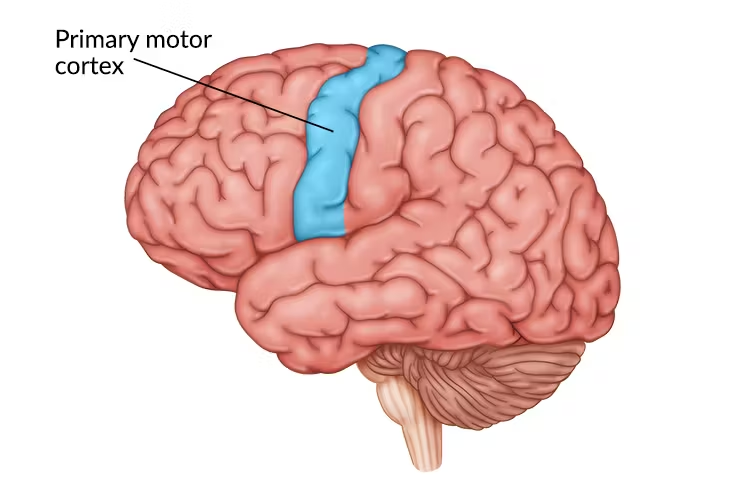
The motor cortex
Ferrier's picture is the motor cortex as a library of short melodies rather than tones. Stimulation calls forth a coordinated action from a series of muscle groups: notes versus melodies, twitches versus movements.
The distinction fell out of the stimulating current itself — galvanic, a continuous direct current, against faradic, alternating in short pulses.
Kinetics vs. kinematics
Kinetics is the physics of motion, also called dynamics, described by applying forces. The question it poses: are neurons responsible for representing forces, or positions? Evarts found that most of them — 26 of 31 — were encoding force in a weighted rod exercise.
Kinematics is movement in the physical world directly. Georgopoulos asked whether it is better to talk about how neurons affect the muscles, or how they affect the movement. The answer he found was to think about it in terms of movement.
In the direction tuning task, one third of the neurons were direction based.
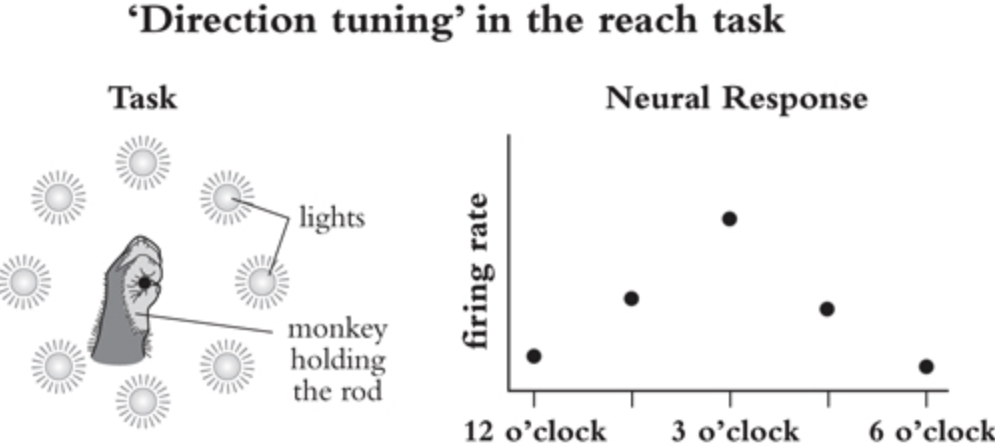
Seems there may be no hope?
Like reading tea leaves, this approach can be used to create an impression by projecting conceptual schemes on to suggestive patterns. Fetz, on the hunt for representations in the brain
It seems that perhaps there is no single value that neurons code for. Scientists made a traditional correlation versus causation error.
Dimensionality reduction
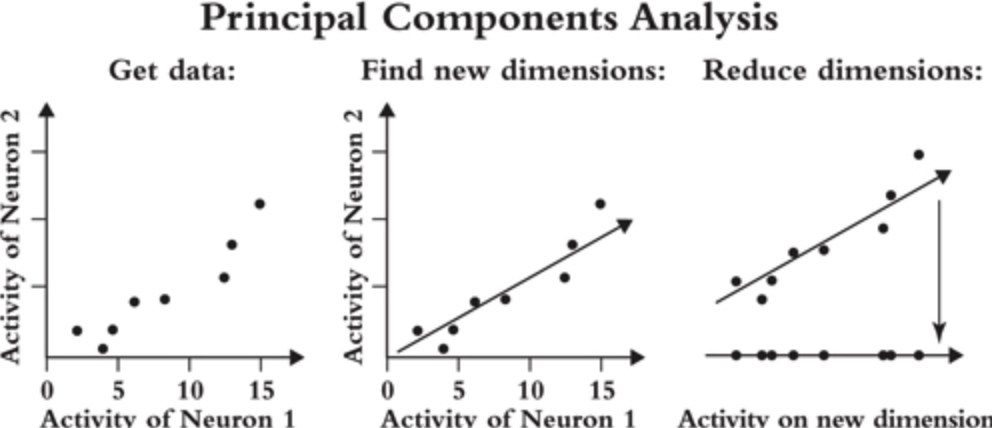
We can assume there is a certain degree of redundancy in any considerably granular series of measurements of the brain. We can reduce the dimension by allowing correlated inputs to be broken down into a lower number of latents.
Principal component analysis is the example: it shows the dimensions of highest variance, and those are the most informative.
BCI
The goal is to write a program for each action the software will need to call — left, right, up, down, mouse click, and the rest.
Noise may be removed via PCA, but the translation from EEG signal during tasks to primitives is not trivial, and usually relies on other classifiers.
InteractiveThe calibration task
Four directions, six keys, and a mapping you were never told. Reach eight targets with a decoder you have to learn from scratch — the same problem the monkey has in Fig. 2.
Play →Further questions
The role of redundancy and efficiency in the brain. What allows us to survive and adapt the best? Why do we seem to have settled on such a multilevel and dynamic system of organization?
Why is there no single way to encode that rules all? Why does the brain get a benefit from encoding signals in such a haphazard way?